Drinking and Other Drugs
Use the timer below to time yourself as you read this section and quiz yourself at the end! When completed please pause the timer and move to the next lesson.
[simplestopwatch]Drinking and Driving Habits
Impaired Driving
Drinking while driving laws and our culture’s attitude regarding impaired driving, along with safer cars, have led to a dramatically lower number of Americans killed every year by drunk drivers.
In 1980, approximately 25,000 Americans were killed by drunk drivers. By 2013, that number shrank to about 10,000. Since then, the number has increased slightly to 10,500 by 2018.
How did that happen? In the mid-1980’s, Mothers Against Drunk Drivers (MADD) and others raised awareness of the deadly and easily preventable drunk driving behavior. States mandated tougher laws and more businesses fired employees for DUI offenses. Since DUI convictions stay on one’s record for an average of 7 years, potential employers tend to shy away from hiring people convicted of DUIs. With the internet, a click of a button reveals someone’s DUI record, so tougher laws, vigorous law enforcement and a society intolerant of drunk driving offenders motivate people to take Uber, Lyft, taxis or designate a sober driver or choose to drink at home.
The first ability to be impaired by alcohol or other drugs is judgement/decision making. Frequently, a drunk person thinks, “I’ve got a good buzz, but I am ok to drive.” When legal and societal penalties for DUIs were minimal, the person thought the low risk of penalties was worth driving impaired, and as a result many more people died.
Now days, the drunk drivers realize their career, finances and reputation can and will vanish due to one bad decision. They probably do not acknowledge or realize the risk of killing himself or others but may be well aware of the legal and financial consequences which deters that person from driving.
Every 53 minutes, a person in the United States dies in an alcohol-related traffic accident. That’s 28 lives lost each and every day.
The National Institute on Alcohol Abuse and Alcoholism reports that nearly 88 percent of those aged 18 and older have consumed alcohol at least once in their lifetime, and about 57 percent have had an alcoholic beverage in the past month.
Drunk Driving Statistics
These startling statistics prompted us to look into the prevalence of drinking and driving in America with over 2,000 U.S. residents were asked to be honest about their history of driving while under the influence of alcohol. Our findings and research below reveal the alarming rate of people getting behind the wheel after drinking, and show the need for education and prevention of this deadly habit.
The Demographics of Drinking and Driving
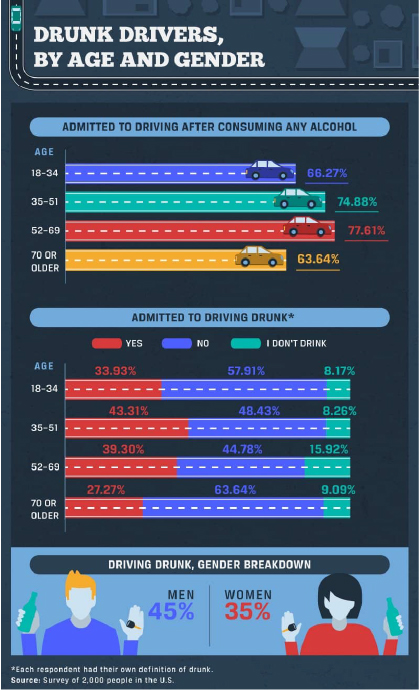
From 2003 to 2012, there was a nearly 21 percent increase in women 18 and over arrested for driving under the influence (DUI) and an 18.6 percent increase in women arrested for drunkenness. Despite this increase, men were still responsible for the majority of DUI arrests in 2012 – almost 650,000 compared with about 211,000 for women. These statistics correspond to our survey results that show 45 percent of men and 35 percent of women admitted to driving drunk.
Driving drunk doesn’t just result in arrest. In 2014, 9,967 people died in alcohol-related traffic accidents. Sixty-four percent of those fatalities were drivers with a blood alcohol content (BAC) level of 0.08 or greater, and 36 percent were passengers and nonintoxicated drivers.
While driving with a blood alcohol concentration (BAC) of less than .08% will not automatically result in a DUI, if that driver failed the field sobriety test in the officer's judgement, he would be arrested. All field sobriety tests are videotaped from the officer's car. The judge or jury could convict the defendant based on that evidence. However, many don’t recognize this as a danger and don’t realize how few drinks it takes to impair or legally intoxicate a person. Over 69 percent of our respondents admitted to driving after consuming some alcohol. About 65 percent said they believe they are OK to drive after having one to two drinks, with another 15 percent saying three to four drinks is acceptable. In reality, just one drink may impair a person’s ability to drive.
Raising awareness of buzzed driving is crucial. Students at Brigham Young University created an ad campaign that helped spread the message, and police departments frequently warn that “buzzed driving is drunk driving” during holidays to keep the roads safe. There are also frequent news stories of fatal accidents caused by drivers who thought they could drive safely after drinking.
A Regional Look at Drinking and Driving Facts
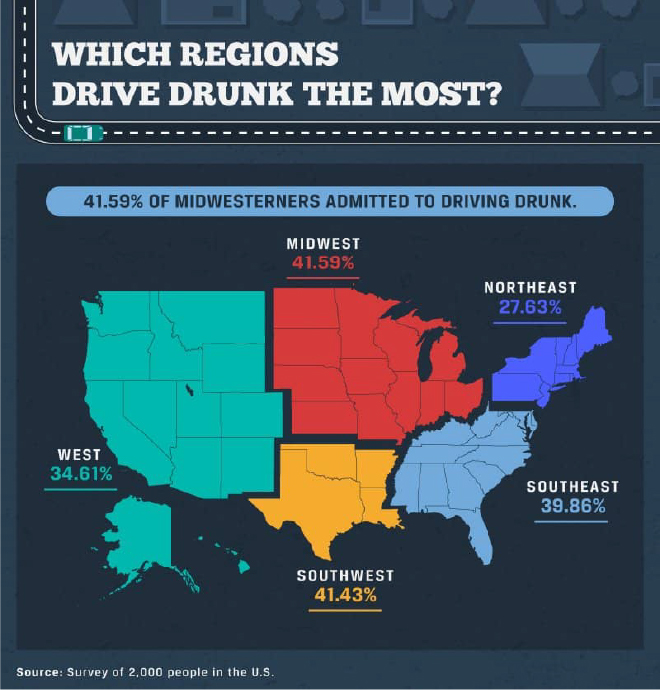
Drunk driving happens all over the United States, and there is no “safe zone” from its dangers. There are, however, regions that show a greater prevalence, and this is where increased education and awareness is needed most. Nearly 37 percent of our respondents admitted to driving drunk at some point in their lives, with the Midwest being the region with the highest proportion (41.6 percent).
A study covered by USA Today revealed that three of the 10 most dangerous states for drunk driving were in the Midwest: North Dakota, Wisconsin, and South Dakota. The Centers for Disease Control and Prevention (CDC) reported that North Dakota had a drunk driving–fatality rate per 100,000 people of 11.3 in 2012, which is over three times the national rate of 3.3. The rate in South Dakota was 5.7, a 53 percent difference from the national rate.
Wisconsin is the only state where driving while intoxicated is not a misdemeanor – or even a “crime” –for the first offense (unless a passenger in the vehicle is under 16). Many people and advocacy organizations, such as Mothers Against Drunk Driving (MADD), take issue with Wisconsin’s operating while intoxicated (OWI) law – especially given the frightening national statistic that drunk drivers have driven while intoxicated more than 80 times before their first arrest, according to MADD. Wisconsin lawmakers did make a move in the right direction with a new law that will allow officers to require first-time offenders to undergo a blood test to check for alcohol levels.
How to control the effects of alcohol.
As a pedestrian, passenger or driver, you may have to deal with the problem of alcohol and traffic safety, whether you drink or not. There are ways to control alcohol rather than letting it control you or your friends. In fact, if you are less than 21 years of age, it is illegal in all states for you to buy, possess or consume alcoholic beverages. But what if circumstances are such that alcohol becomes a factor you have to deal with? For example, suppose you are 21 or traveling with someone who is 21. You attend a wedding reception or other celebration and you or your companion decides to drink.
Remember that drinking any amount of alcohol will impair driving ability. Your safest option is to not drink and drive, and to not ride with a driver who has been drinking. Instead, get someone else to drive, Uber, Lift, Taxi or someone else who is 100% sober.
In addition to stricter laws, other strategies for reducing and preventing drunk driving that all states and areas of the country can implement sobriety checkpoints, ignition interlocks, and school-based instructional programs.
Weekly Drinking Habits
Almost 53 percent of people who reported drunk driving on at least one occasion consume between one and four alcoholic beverages per week. The prevalence goes down from there but then escalates for those who drink over 16 beverages per week (over 7 percent of our drunk driver respondents).
Often the more regularly or frequently a person drinks, the greater the chance he or she will get behind the wheel after consuming alcohol. Our survey results indicate a pattern for this, with nearly 86 percent of our respondents who said they drink more than 16 alcoholic beverages a week also admitting to drunk driving.
The CDC defines heavy drinking as consuming eight or more drinks per week for women and 15 or more drinks per week for men. Excessive drinking and alcohol abuse can lead to alcoholism or a physical dependence on alcohol.
Is Driving Drunk Ever Safe?
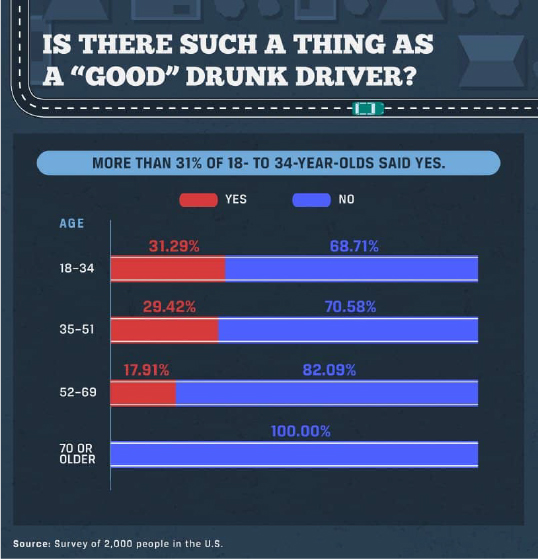
A drunk person should never drive, no matter how good of a driver they think they are. Unfortunately, nearly 32 percent of our respondents aged 18 to 34 said they believe there are people who are good at drunk driving.
This age range is connected to college-aged students, presenting a dangerous connection between frequent drinkers who may also be overly-confident drunk drivers. Drinking among college students is extremely prevalent. In 2014, almost 60 percent of full-time college students aged 18 to 22 said they consumed alcohol in the past month, nearly 38 percent participated in binge drinking in the past month, and over 12 percent reported heavy drinking (consuming at least five drinks in one session on five or more occasions per month) in the past month. All of these numbers were higher than noncollege students of the same age.
One of the worst mistakes a drunk college student can make is getting in the driver’s seat of a vehicle. Education and awareness of the dangers of drunk driving are vital to reducing the incidence of drunk driving. Following the DUI arrest of a University of Georgia defensive lineman, football players there were vocal about supporting their fellow teammates in obtaining a ride after they’ve been drinking. At Hartwick College, there have been programs to warn students of the perils of drunk driving, including a mock DUI crash and a simulated drunk driving event.
Driving Drunk With Passengers
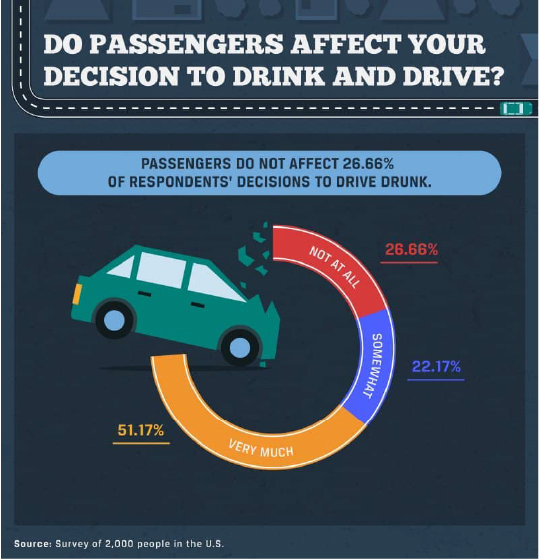
Over 73 percent of our survey respondents said that having passengers in their vehicle affects their decision to drive drunk. But what about the other drivers and their passengers on the road? In 2014, passengers riding with a driver who had a BAC of 0.08 or higher made up 15 percent of all fatalities caused by alcohol-related crashes, while occupants of other vehicles and pedestrians/bicyclists composed 20 percent of drunk driving deaths.
One woman in South Florida is suffering the consequences and pleading for forgiveness for her poor choice to drive drunk haphazardly in 2013. Minutes before crashing into another vehicle and killing its two occupants, she tweeted “2 Drunk 2 Care.” A Texas State student was arrested for allegedly drunk driving and crashing into a vehicle with a man and his pregnant wife; the man and unborn child died. In Maryland, a former federal officer was sentenced to 10 years in prison for killing a woman in a head-on collision while driving drunk.
These are just a few of the stories of lives tragically lost by drunk drivers. Many of the victims’ families request more awareness for drunk driving and aim to educate the community on how quickly and drastically lives can change when drinking and driving are combined.
Taking Action Against Drunk Driving
With 28 people dying every day in America due to drunk driving, it’s essential that our country increases the education and awareness for drinking and driving. While certain demographics, such as college students, have a higher risk for driving while under the influence of alcohol, our survey revealed that no group is “safe.” Over 60 percent of each age range admitted to consuming alcohol and then driving, and 35 percent of women and 45 percent of men reported driving drunk.
The legal penalties for alcohol-related vehicular manslaughter are steep in many states, prison sentences can be as long as 20 or 30 years. In Alaska, an airman with a BAC of 0.20 faced 99 years in prison for killing a woman in a fatal accident; he was sentenced to a maximum of 30 years. Of course, a prison sentence doesn’t compare with the outcome for victims who lost their lives.
Police departments, organizations such as MADD, families of victims killed by drunk drivers, and concerned citizens all across the country are speaking out to encourage those who have been drinking to not get behind the wheel. National, state, and community-wide interventions like sobriety checkpoints and ad campaigns can reduce the incidence of drunk driving.
Don’t let the effects of alcohol cloud your judgment and ruin your life and possibly the lives of many others. If you are worried about your alcohol consumption and ability to make decisions regarding drinking, reach out for support today. Call 1-888-919-3845 to find out more about -alcoholism treatment options today.
Source:Alcohol.org
Drugs and Driving
Many substances can impair driving, including alcohol, some over-the-counter and prescription drugs, and illegal drugs.
Alcohol, marijuana, and other drugs impair the ability to drive because they slow coordination, judgment, and reaction times.
Cocaine and methamphetamine can make drivers more aggressive and reckless.
Using two or more drugs at the same time, including alcohol, can amplify the impairing effects of each drug a person has consumed.
Some prescription and over-the-counter medicines can cause extreme drowsiness, dizziness, and other side effects. Read and follow all warning labels before driving, and note that warnings against “operating heavy machinery” include driving a vehicle.
Impaired drivers can’t accurately assess their own impairment – which is why no one should drive after using any impairing substances. Remember: If you feel different, you drive different.
Marijuana Impairs
There are many misconceptions about marijuana use, including rumors that marijuana can’t impair you or that marijuana use can actually make you a safer driver.
Several scientific studies indicate that this is false. Research shows that marijuana impairs motor skills, lane tracking and cognitive functions (Robbe et al., 1993; Moskowitz, 1995; Hartman & Huestis, 2013). A 2015 study on driving after smoking cannabis stated that THC in marijuana also hurts a driver’s ability to multitask, a critical skill needed behind the wheel.
NHTSA continues to conduct research to better understand the relationship between marijuana impairment and increased crash risk. NHTSA’s Drug and Alcohol Crash Risk Study found that marijuana users are more likely to be involved in crashes. However, the increased risk may be due in part because marijuana users are more likely to be young men, who are generally at a higher risk of crashes.
While evidence shows that drug-impaired driving is dangerous, we still have more to learn about the extent of the problem and how best to address it. In January 2018, NHTSA launched a new initiative to address drug-impaired driving. NHTSA’s National Drug-Impaired Driving Initiative brings together experts, including law enforcement officials, prosecutors, substance abuse experts and others, to discuss strategies that can reduce drug-impaired driving.
It’s Illegal
Driving impaired by any substance—alcohol or drugs, whether legal or illegal—is against the law in all 50 states and the District of Columbia. Law enforcement officers are trained to observe drivers’ behavior and to identify impaired drivers. Even in states where marijuana laws have changed, it is still illegal to drive under the influence of the drug.
NHTSA’s National Roadside Survey conducted in 2013-2014 (PDF, 173 KB) found that 20 percent of surveyed drivers tested positive for potentially impairing drugs.
Surveys conducted by NHTSA show the number of drivers testing positive for marijuana increased between 2007 and 2014. In 2007, NHTSA’s National Roadside Survey (PDF, 1 MB) found that 8.6 percent of weekend nighttime drivers tested positive for marijuana. In the 2013-2014 survey, 12.6 percent of weekend nighttime drivers tested positive for marijuana. That’s a 48-percent increase in less than 10 years.
While the presence of a drug in a driver’s system doesn’t necessarily mean that they’re impaired, these findings show the importance of raising awareness about the risks of drug-impaired driving.
Responsible Behavior
We can all save lives by making smarter choices.
If you use an impairing drug, designate a sober driver, call a cab, or use a ride-hailing service.
Don’t let friends get behind the wheel if they’re under the influence of drugs or alcohol.
If you’re hosting a party where alcohol or other substances will be used, it’s your job to make sure all guests leave with a sober driver.
Always wear your seat belt—it’s your best defense against impaired drivers.
Any time you consume a substance that makes you feel different, you aren’t safe to drive. Impaired driving isn’t a mistake; it’s a crime.
Those who drive under the influence of alcohol or drugs, whether obtained legally or illegally, pose a danger to themselves, their passengers, and other road users.
Source: NHTSA